Sleekflow Alternatives 2026
SleekFlow is a WhatsApp-first messaging and social commerce platform. Best suited for e-commerce and retail teams selling through chat, particularly in Asia-Pacific markets where WeChat, LINE, and Viber matter.

Messaging-first unified inbox with flat pricing. WhatsApp, Telegram, Messenger, Discord, Zalo in one place.
Zendesk is customer service software and support ticketing system. Best suited for large enterprises needing comprehensive ticketing with compliance requirements and deep third-party integrations. Known for its industry-leading ticketing system with 1000+ integrations and enterprise-grade compliance.
Freshdesk is Freshworks' customer support platform, sold as two separate product lines: standard Freshdesk (email-first ticketing, $19-$89/agent/mo) and Freshdesk Omni (messaging plus ticketing, $29-$119/agent/mo). We re-checked both Freshworks pricing pages on 5 August 2026 — the long-running Free plan is gone from the public rate card and survives only as an in-app, six-month, two-agent Free Program on the standard line. Freddy AI is the standout, but Copilot is a $29/agent/mo add-on on top of whichever plan you pick.
Intercom is an AI-first customer service platform best suited for well-funded SaaS companies that want product tours, in-app messaging, and an AI agent that answers front-line questions. Checked 3 August 2026: the three per-seat plans (Essential, Advanced, Expert) still list at $29, $85, and $132 per seat annually, and Fin AI still bills $0.99 per outcome — so the headline seat price is rarely the real cost. Two things did change this year: the company renamed itself Fin in May 2026, and Salesforce signed a definitive agreement to acquire it in June 2026. The helpdesk product keeps the Intercom name.
Help Scout is customer service platform for growing businesses. Best suited for small-medium businesses wanting a clean, email-focused helpdesk with strong knowledge base and self-service features. Known for its docs knowledge base with AI Answers for self-service resolution.
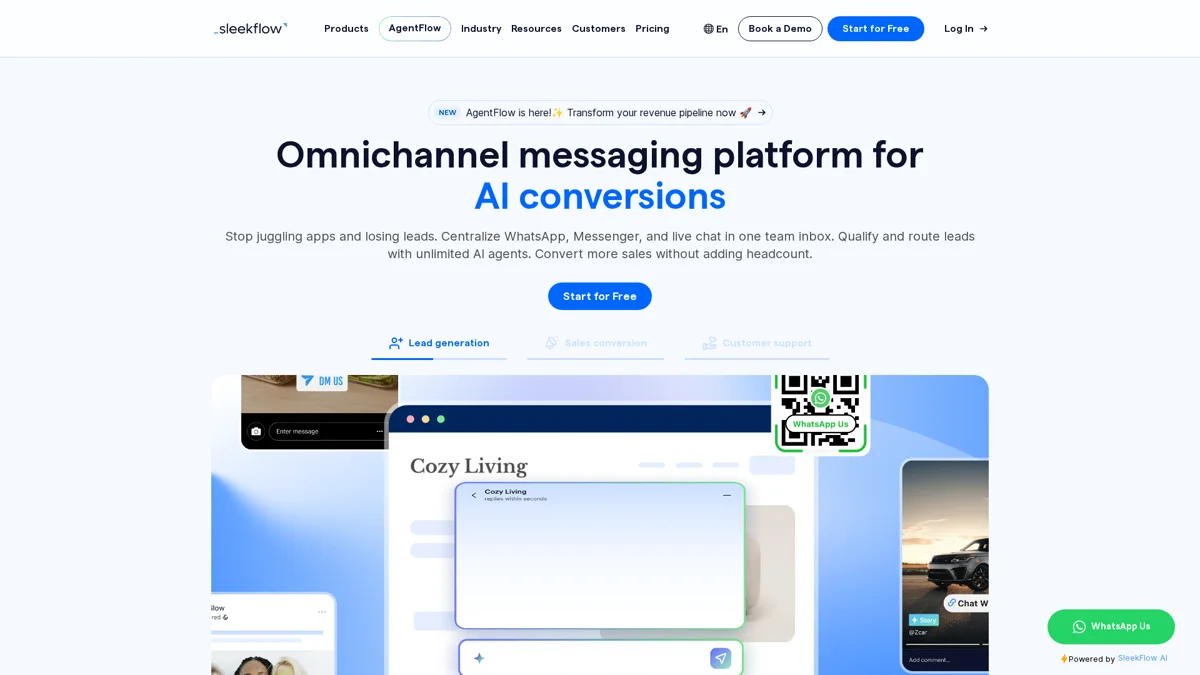
SleekFlow is a WhatsApp-first messaging and social commerce platform, headquartered in Hong Kong, that now positions itself as an "AI Suite for Revenue-Driving Conversations." It connects nine messaging channels — WhatsApp, Instagram, Facebook Messenger, WeChat, LINE, Telegram, Viber, SMS, and a live chat widget — into one inbox, and layers AI Agents, a visual Flow Builder, broadcast campaigns, and a ticketing system on top. SleekFlow reports 5,000+ customers and a 4.6/5 G2 average across 170+ reviews (SleekFlow, checked 20 August 2026).
People search for SleekFlow alternatives for one of two reasons, and they pull in opposite directions. The first is cost shape: SleekFlow bills on monthly active contacts with hard user and channel caps per tier, so the price moves with engagement rather than headcount. The second is scope — SleekFlow is built to sell through chat, and teams whose work is post-sale support end up paying for a commerce engine they never open. Converge sits at the opposite end: $49/month flat for up to 15 agents, a support inbox rather than a sales one.
What features does Sleekflow offer?
Sleekflow's feature set is built around what its target customer base values most — its biggest differentiator versus the alternatives below. It uses a usage-based pricing model starting at From $149/mo, a different cost structure from a flat-rate alternative like Converge ($49/month for up to 15 agents, all channels and AI included). Features typically split across channel coverage, automation depth, AI tooling, and team management — the grid below shows what matters most for a unified-inbox use case.
Why should you look for Sleekflow alternatives?
Teams look for Sleekflow alternatives because of structural limitations that reviewers on G2 and Capterra consistently flag — pain points that compound as the team scales past initial setup.
Most teams leave SleekFlow over cost shape rather than missing features — the tier caps bite before the feature set does. But one structural gap and one external pricing shift matter more than anything on the feature grid.
Where does SleekFlow's tier structure bite first?
The Pro AI plan caps at 3 users and 3 channels. That second cap is the one teams hit unexpectedly: WhatsApp, Instagram, Messenger, and a website widget is four connections, which already forces Premium at $349/month yearly. Role-based access control is also Premium-only, so a 3-person Pro team shares one permission level — every agent can see and do everything.
The other structural gap is email. SleekFlow has no email channel at all; it uses email only for internal agent notifications. If some of your customers write to a support address, that traffic lives in a separate tool permanently. For a sales-through-chat team this is irrelevant. For a support team it means the "unified inbox" is not actually unified.
Migration friction is the third factor. Because SleekFlow is a Meta Business Solution Provider, your WhatsApp Business Account is hosted under its infrastructure, so leaving requires disabling two-factor authentication on the WABA and releasing the number — not just disconnecting an integration.
How does Meta's October 2026 pricing change affect a WhatsApp-first platform?
This is the change most SleekFlow comparisons have not caught up with, and it hits the variable half of the bill rather than the subscription.
Meta's developer documentation confirms two updates taking effect 1 October 2026. Service messages — the ordinary replies an agent sends inside the 24-hour customer service window — become billable per message, having been free since November 2024. Utility templates sent in response to users inside that window also become billable, having been free since July 2025. Meta states service messages will be charged at each market's utility and authentication rate, with no volume tiers, and that the October rates will be published by 1 September 2026. Separately, from 1 August 2026, Meta charges per token for messages powered by its own Meta Business Agent, at $2.00 per million tokens (roughly 4-5 cents per message).
The practical consequence: inbound support conversations, which are the bulk of a support team's WhatsApp volume and currently cost nothing per message, stop being free. This is Meta's charge and applies through every BSP — SleekFlow, Converge, or anyone else. It matters more for WhatsApp-first vendors simply because a larger share of their customers' volume sits in that window. If your evaluation assumed free inbound replies, re-run it against the rates Meta publishes in September.
What does the channel coverage comparison look like?
SleekFlow's nine channels lean toward Asian markets: WhatsApp, WeChat, LINE, Viber, Telegram, Instagram, Messenger, SMS (via Twilio), and a live chat widget. WeChat requires a Service Account with an annual verification fee of roughly $99 and allows only four broadcasts a month outside its 48-hour window. Discord, Zalo, and email are absent.
Converge covers WhatsApp, Telegram, Discord, Instagram, Zalo, Messenger, X, and email, with AI reply suggestions, visitor tracking with UTM attribution, and lead capture included at $49/month flat. It has no social commerce layer — no in-chat payments, no product catalogs, no cart. The two products overlap on the inbox and diverge on whether the job is selling or supporting.
Strengths
- Strong Asia-Pacific focus
- Good e-commerce integrations
- WeChat support
- AI-powered automation
Limitations
- Headline price is the annual rate — monthly billing costs 33% more
- Pro AI caps at 3 users and 3 channels
- Monthly active contact limits force add-ons or a tier jump
- WhatsApp number hosting plus Meta message fees on top of subscription
How much does Sleekflow cost?
Sleekflow pricing starts at From $149/mo on a usage-based model — but that listed price rarely reflects what teams actually pay. Real cost depends on team size and how the model scales with headcount, channel count and per-channel surcharges, premium-tier gating that surfaces after signup, and add-ons for advanced reporting, premium support, or compliance. The tier breakdown below lists what each plan includes alongside its monthly price.
We re-checked every figure below against SleekFlow's live pricing page on 20 August 2026. The headline $149 is the yearly-billed AI rate; month-to-month it is $199, and the tier caps at 3 users and 3 channels.
What does each SleekFlow tier actually cost?
SleekFlow's pricing page shows four numbers per tier, and only one of them is the one most comparison articles quote. Each plan splits two ways: yearly versus monthly billing, and "unlimited AI" versus the non-AI variant.
- Free — $0, 50 monthly active contacts, live chat widget, unlimited contact storage. AI is a usage-limited trial, not unlimited, and broadcasts are excluded.
- Pro AI — $149/month billed yearly, $199/month billed monthly. Non-AI Pro is $119 yearly / $149 monthly. Includes 3 users, 3 channels, 500 MACs.
- Premium AI — $349/month billed yearly, $399/month billed monthly. Non-AI Premium is $299 / $349. Includes 5 users, 10 channels, 1,000 MACs.
- Enterprise AI — custom, with unlimited channels, Salesforce integration, and PII masking.
Two details are easy to miss. Pro AI is capped at 3 channels, not just 3 users — connecting WhatsApp, Instagram, Messenger, and a website widget already exceeds it. And Premium has no self-serve checkout: the button is "Book a Demo," so the real entry point is a sales call. SleekFlow also sells a one-off $499 60-day onboarding package.
How does the monthly active contact model change your bill?
SleekFlow bills on monthly active contacts, not stored contacts. A contact counts when they message you, or when you message them through the Inbox, Flow Builder, AI Agent, WhatsApp co-existence, or API. Someone who receives a one-way broadcast and never replies does not count, and storage is unlimited on every tier.
That model is genuinely fairer than per-contact billing, but it makes your bill move with engagement rather than headcount — the opposite of a per-seat tool. SleekFlow's own estimate is that a business chatting with 20 unique customers a day uses about 450 MACs a month, which sits just under the Pro AI allowance of 500. A campaign month, a product recall, or a seasonal peak pushes you into add-ons (capped at 2,000 on Pro, 12,000 on Premium) or a tier upgrade. Budgeting is hardest precisely when support demand spikes.
The "unlimited" labels on AI usage, broadcasts, and Flow Builder are all governed by a Fair Use Policy that SleekFlow says affects under 1% of users.
What does WhatsApp add on top?
SleekFlow's FAQ states the WhatsApp Business API cost as the subscription "+ phone connection + hosting fees USD 15," and Meta's per-message rates are billed separately through a credit wallet that suspends messaging if the balance goes negative.
So a realistic monthly-billing Pro AI team with one WhatsApp number starts at $214/month ($199 + $15) before any template message. The same team on yearly billing is $164/month, but pays a full year up front. A 5-agent team needs Premium: $364/month yearly, $414 monthly.
Converge is $49/month flat for up to 15 agents with no contact limits, no per-channel caps, and no per-number hosting fee. Meta's message rates apply on any platform — they are Meta's charge, not the vendor's.
What are the top Sleekflow alternatives?
Side-by-side breakdown of features, pricing, and trade-offs.
The top Sleekflow alternatives split into two categories serving different team profiles. First, messaging-first unified-inbox platforms built for 3-15 agent teams handling real-time conversations across channels — Converge sits in this category at $49/month flat. Second, traditional ticketing and helpdesk platforms built for larger teams with email-heavy or compliance-heavy workflows. The comparison below covers features, pricing model, and best-fit team type for each.
Converge
Best ValueMessaging-first unified inbox. Flat pricing, all channels included.
Strengths
- $49/month flat rate for up to 15 agents
- Native WhatsApp, Telegram, Messenger, Discord, Zalo
- Unified inbox for real-time conversations
Limitations
- No standalone knowledge base
- Not suited for email-heavy workflows
- No HIPAA/SOC2 compliance

Zendesk
Customer service software and support ticketing system
Strengths
- Industry-leading ticketing system with mature workflows
- Massive integration ecosystem with 1000+ apps
- Enterprise-grade security and compliance (HIPAA, SOC2)
Limitations
- Per-agent pricing scales quickly -- add-ons can double the per-seat rate
- AI Copilot is $50/agent/mo extra on top of base plan
- AI resolutions above the plan allowance are metered at $1.50-$2.00 each

Freshdesk
Cloud-based customer support software by Freshworks
Strengths
- Mature platform with proven reliability at scale
- Email-only teams can pay $19/agent/mo rather than buying messaging they will not use
- Strong automation and workflow capabilities
Limitations
- Two separate product lines priced differently — pick the wrong one and messaging costs a migration, not an upgrade
- Omnichannel messaging requires Omni plans ($29+/agent/mo)
- AI Copilot is $29/agent/mo extra and unavailable at all on Growth or Omni Growth

Intercom
AI-first customer service platform
Strengths
- Fin AI Agent resolves queries autonomously with high accuracy
- Beautiful, modern interface design
- Strong product tour and in-app onboarding features
Limitations
- Per-outcome Fin AI fees ($0.99 each) add up fast at volume
- Premium per-seat pricing plus Pro and Proactive Support add-ons can reach $150+/seat/mo effective
- No native Telegram or Zalo support; Discord added natively in March 2026

Help Scout
Customer service platform for growing businesses
Strengths
- Clean, intuitive interface loved by support teams
- Excellent email-focused support with collision detection
- Strong knowledge base (Docs) for self-service
Limitations
- WhatsApp only available on Plus tier ($45/user/mo)
- No native Telegram, Discord, or Zalo support
- AI Answers charged per resolution ($0.75 each)
How do Sleekflow alternatives compare?
Compared head-to-head, Converge ($49/month flat for up to 15 agents) is consistently the cheapest option for messaging-first teams under 15 agents and includes WhatsApp, Telegram, Messenger, Instagram, Discord, and Zalo plus AI tooling in the base subscription. The other major Sleekflow alternatives use per-seat models that scale linearly with headcount, compounding past the 3-5 agent threshold. The table below shows starting prices and best-fit profiles for each alternative.
Which Sleekflow alternative is best for messaging-first SMBs?
For messaging-first SMBs under 15 agents, Converge is consistently the best Sleekflow alternative on the dimensions that matter in practice. It includes native support for WhatsApp, Telegram, Messenger, Instagram, Discord, and Zalo (the only platform with native Zalo integration) at $49/month flat for up to 15 agents — no per-seat fees, no per-channel add-ons, no premium-tier gating around AI features. The verdict below shows where teams choose Converge and where a different platform fits better.
If your team primarily uses messaging channels (WhatsApp, Telegram, Messenger, Instagram, Discord, Zalo) and wants predictable pricing, Converge is worth considering.
Why teams choose Converge
- $49/month flat rate for up to 15 agents
- Native messaging channels most treat as add-ons
- Unified inbox for real-time conversations
When to choose something else
- Enterprise compliance (HIPAA, SOC2)
- Email/ticket-heavy workflows
- Advanced automation requirements
Do not switch away from SleekFlow if any of these describe you. You run outbound broadcast campaigns as a revenue channel — SleekFlow's broadcast engine, Flow Builder abandoned-cart recovery, and Stripe payment links have no equivalent in a support-first inbox, and replacing them means buying a second tool. You depend on WeChat, LINE, or Viber; those channels are genuinely hard to find elsewhere, and losing them to save on subscription cost is a bad trade. You use AI Agents to close conversations autonomously rather than to assist a human. Or your billing is stable well inside the MAC allowance and you are on yearly billing — at $164/month all-in for three agents, the saving from switching is real but modest against migration effort that includes a BSP-level WhatsApp release.
Switch if the caps, not the features, are what you keep hitting. The clearest signals: you need a 4th agent or a 4th channel and are staring at the $149$349 jump; you are on monthly billing and paying the 33% premium; your customers email you and that traffic sits in a separate tool; or your MAC usage spikes with campaigns and you are buying add-ons to cover peaks. Those are pricing-model problems, and no amount of SleekFlow configuration fixes them.
Converge fits the second group specifically: $49/month flat for up to 15 agents, no contact limits, no channel caps, email in the same inbox as messaging, plus Discord and Zalo. It is not a commerce platform, and if you recognized yourself in the first paragraph, stay where you are.
Frequently Asked Questions
Checked on SleekFlow's pricing page on 20 August 2026: Pro AI is $149/month only on yearly billing — month-to-month it is $199. Premium AI is $349 yearly and $399 monthly. Dropping unlimited AI gives a cheaper non-AI Pro at $119 yearly / $149 monthly. On top of the subscription, SleekFlow's own FAQ lists a $15 WhatsApp phone connection and hosting fee, and Meta's per-message rates are billed separately. A monthly-billing Pro AI team with one WhatsApp number therefore starts at $214/month before a single template message.
Meta's developer documentation confirms that from 1 October 2026 it will charge per message for service messages (replies inside the 24-hour customer service window) and for utility templates sent in response to users. Both have been free since November 2024 and July 2025 respectively. Service messages will be priced at each market's utility and authentication rate with no volume tiers. Because SleekFlow's pricing is layered on top of Meta's rate card, the variable half of a WhatsApp-first bill rises even though SleekFlow's own subscription price does not change — inbound support replies stop being free.
Yes. Pro AI includes exactly 3 user accounts and 3 channels. A 4th agent means moving to Premium AI at $349/month yearly ($399 monthly) — roughly 2.3x the price for one extra seat, with no tier in between. SleekFlow does list user add-ons on both Pro and Premium, so ask sales for the per-seat add-on rate before accepting the full tier jump.
Go to Contacts in the side menu, navigate to the specific list you want to export, click More actions, then select Export list. SleekFlow generates a CSV with all contact properties as column headers. Export progress appears at the bottom left of the screen. Exports are per-list — repeat for each contact list separately.
SleekFlow's Analytics > Conversations tab has an Export button that generates a CSV with daily aggregated metrics (conversations, messages, response times) for up to 180 days. This is aggregated data, not raw message-level history. For individual message data, use the Platform API (Integrations > Platform API > Connect, admin access required) which covers Contacts, Messaging, Inbox, and Analytics modules.
Two methods: (1) On the Broadcasts page, hover over a campaign, click the three-dot menu, and select Export .CSV. (2) Open a broadcast's settings, go to the History tab, and click Export .CSV in the top right. The CSV includes per-recipient data: contact name, delivery status (Sent/Delivered/Read/Replied/Failed), phone number, labels, last updated, and remarks. WeChat, SMS, and Telegram channels do not report Read delivery status.
Flow Builder automations (visual workflows, triggers, branching logic), AI Agent configurations (knowledge base files, custom answers, action settings), label hierarchies, custom objects, assignment rules, and quick reply templates cannot be exported through any method. Screenshot your Flow Builder workflows, note your label structure, and manually copy canned response text before canceling.
The top Sleekflow alternatives are Zendesk, Freshdesk, Intercom, and Converge. Each offers different strengths: Zendesk for Large enterprises needing comprehensive ticketing, and Converge for messaging-first teams with flat $49/month pricing.
Sleekflow starts at From $149/mo. Additional costs may include add-ons, annual billing requirements, and implementation fees.
Sleekflow can work for small businesses, though per-seat pricing scales with team size. Alternatives like Converge offer flat-rate pricing ($49/month for up to 15 agents) better suited for SMBs.
Sleekflow's main limitations include: Headline price is the annual rate — monthly billing costs 33% more; Pro AI caps at 3 users and 3 channels; Monthly active contact limits force add-ons or a tier jump. These factors lead many teams to explore alternatives.
Sleekflow at From $149/mo is on the higher end compared to alternatives. Zendesk starts at From $19/seat/mo. Converge offers flat $49/month for up to 15 agents, eliminating per-seat scaling.
Ready to try Converge?
$49/month flat. Up to 15 agents. 7-day free trial, no credit card required.
Start Free Trial